Project 2: Operando Characterization of Assembly Pathways in Integral Asymmetric Membranes
Project 2 of GAP C will experimentally unveil the formation process of integral asymmetric UMCP-based membranes. Project 1 (Fredrickson, Ganesan) will provide preliminary estimates of the kinetic evolution of self-assembly and phase separation, two inherently non-equilibrium processes that are challenging to predict and control/reproduce. Su, Katz, and Crumlin will develop operando scattering tools within the IF that will be used in GAP C to track each stage of the SNIPS process on the sub-micron scale, addressing knowledge gaps that connect block copolymer chemistry, architecture, and processing to isoporous membrane structure. To complement this sub-micron characterization, Squires will develop microfluidic interferometric techniques that track the spatio-temporal evolution of the evaporating solvent and infiltrating non-solvent under controlled conditions across the thickness of the film, directly visualizing both wet and dry steps.
The main steps of the SNIPS process are block copolymer micelle formation in solution, micelle assembly into a microphase-separated skin during solvent evaporation, and nonsolvent-induced macrophase inversion (i.e., NIPS). In situ characterization tools will be employed for each of these three steps.
Step 1: Micelle formation - In situ X-ray scattering techniques (developed in the IF and utilized here) will reveal structure formation and kinetics. Block copolymer micelle structure and size in solution dictate the characteristic pore size and spacing within the skin layer (Fig. 4.2). X-ray scattering of block copolymer micelles in solution (see discussion in the IF Section 5.1.4 and Fig. 5.6) will track the size of block copolymer micelles and inform optimal solvent compositions. Moreover, in situ liquid resonant soft X-ray scattering (RSoXS, developed in the IF), will be used to differentiate the spatial extent of the core vs. shell regions of micelles (Su, Katz). These findings will guide Project 1 experimental efforts to design UMCP SNIPS casting solutions for desired membrane pore sizes and chemistries.
Step 2: Solvent evaporation - After membrane casting, micelles merge as the solvent evaporates, which templates the morphology of the isoporous skin layer in a non-equilibrium state. Understanding the fundamentals of this process requires operando measurements that reveal the evolving concentration profiles of solvent and the structural evolution of the skin layer. This will connect features of solution morphology, e.g., the size of the micelle core, to the morphology of the isoporous skin layer. Such measurements provide feedback to guide block copolymer synthesis (Lynd), validation for physics-based computation (Fredrickson, Ganesan), and feedforward to full membrane structure, mechanical properties, and separation performance (Freeman, Sanoja). The operando X-ray scattering device will be developed in the IF with appropriate time and length scales to be leveraged for tracking the morphology evolution during the solvent evaporation step (cf. IF Section 5.1.4 and Fig. 5.6).
From our simulations, skin layer ordering and growth are driven by concentration profiles that change both spatially and temporally. These rates will be measured using a microfluidic interferometry technique (Squires), (cf. Fig. 4.4), to track the solvent profile across precursor films exposed to a flowing gas of controlled composition (e.g., specified vapor pressure of organic solvent or H2O), with ~1 μm spatial and 100 ms temporal resolution.
Step 3: Macrophase inversion - In situ characterization will also include the observation of structure evolution during nonsolvent immersion. Immersion in a nonsolvent produces the open, porous structure below the skin layer due to macrophase separation between the nonsolvent and polymer. In situ X-ray scattering (developed in the IF by Katz and Su) will reveal if changes in the self-assembled isoporous layer occur upon nonsolvent immersion. Operando characterization of asymmetric membrane formation will be complemented by ex-situ interrogation of previously formed membranes to connect processing conditions to the resulting membrane structure/performance. The UMCP platform provides a route towards isoporous membranes with functionalizable hydrophilic pore walls. Synchrotron infrared nanospectroscopy (SINS) and resonant X-ray scattering (developed in the IF) will be used to map nanoscale morphology with chemical sensitivity, through unique IR signatures of specific functional groups and tunable scattering contrast, respectively, providing unprecedented simultaneous resolution of morphology and chemical structure.
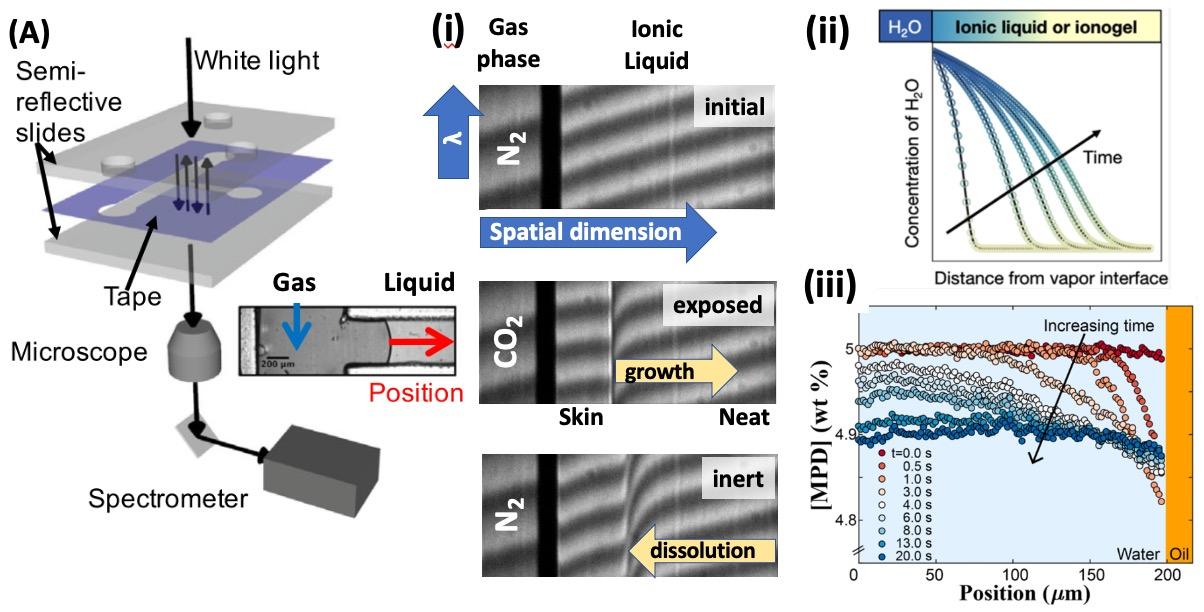
Fig. 4.4. Microfluidic interferometry tracks spatio-temporal evolution of concentration during film drying/ “skin” layer growth.