IF, Project 2: High-throughput Measurements of Membrane-solute Interactions and Macroscopic Characterization
Making effective use of the UMCP material library to design functional membranes requires rapid screening of interactions with solutes. High-throughput experiments will be used to characterize the sorption capacity, selectivity, and permeability of solutes at varying concentrations and feed complexities. Initial efforts to develop high-throughput methodologies in M-WET have focused on:
- UV-vis spectrophotometry on 96 well plates to measure solute sorption/desorption from hydrogels and
- online robotic sampling approaches to measure the membrane permeability of salt mixtures that have significantly different permeabilities and potential interactions between salt sorption processes.
Additionally, robotic methodology (e.g., via a Chemspeed robot) will allow polymer dope casting variables, such as solvent ratios and polymer concentration, to be systematically, rapidly, and accurately varied over wide ranges to determine their influence on final membrane morphology, accelerating the navigation of this complex phase space to identify compositions of interest for isoporous membrane formation.
As an example, we have synthesized ligand functionalized hydrogels based on the non-porous UMCP in a 96 well plate format, as shown in Fig. 5.3, with varying imidazole (ligand) concentrations. This array of hydrogels was then tested for sorption of salts (CuCl2, FeCl3, Cr(NO3)3 and K2CrO4) of varying concentrations. Spatially resolved UV-vis measurements of the hydrogels after exposure to the solutes demonstrate the utility of high-throughput analysis to rapidly assess the influence of hydrogel composition and solute concentration on sorption capacity for various salts (shown in Fig. 5.3 as variations in color and intensity). The IF will develop quantitative use of high throughput UV-vis spectroscopy to measure the thermodynamics and kinetics of uptake of UV-vis active solutes by libraries of materials based on the nonporous UMCP bearing ligands of interest (Christopher and Segalman).
M-WET has developed an automated apparatus for measuring the permeability of mixed-salt feeds that enables rapid screening of solute transport through membranes via on-line robotic sampling. The apparatus incorporates remote, computer-controlled dosing of salt mixtures to a membrane for permeation studies (Fig. 5.4). The system is designed to:
- keep upstream salt concentrations fixed over time frames long enough to study salt mixtures where the components have widely varying permeability (e.g., Li+ and Mg2+ mixtures) and
- continuously replenish the receiver chamber to enable permeability measurements without the influence of osmotic water transport from receiver to donor and allow time dependent variations in salt concentrations.
From these data, ion permeability coefficients can be deduced. While the system was initially designed for automated, highthroughput measurements of mixed salt permeabilities, it can also be used for automated measurements of the permeability of a single salt over a wide range of feed compositions, the permeability of mixtures with variations in concentrations of each salt, and conditioning analysis in which hysteresis and long-time tests examine membrane fouling. Using a similar approach, we will develop an online ionic conductivity instrument, for example, using an electrochemical flow cell (Christopher, Freeman).
Measurements using these high-throughput methodologies will guide membrane synthesis with targeted chemistries, facilitate detailed transport measurements by NMR (Clément), identify candidates for detailed analysis of fouling (IF Project #3), and provide benchmark experimental data for comparison to theoretical modeling (Ganesan). Furthermore, these measurements will be complemented by extensive macroscopic characterization of membranes, including water and solute (e.g., ions or neutral solutes) solubility, diffusivity, and permeability at any conditions relevant for M-WET (Katz, Freeman, Kumar). These PIs also have experience characterizing ionic conductivity, fouling, solute rejection, molecular weight cutoff, free volume (e.g., via positron annihilation lifetime spectroscopy (PALS)), etc. These macroscopic measurement tools will be applied as described above in the GAPs.
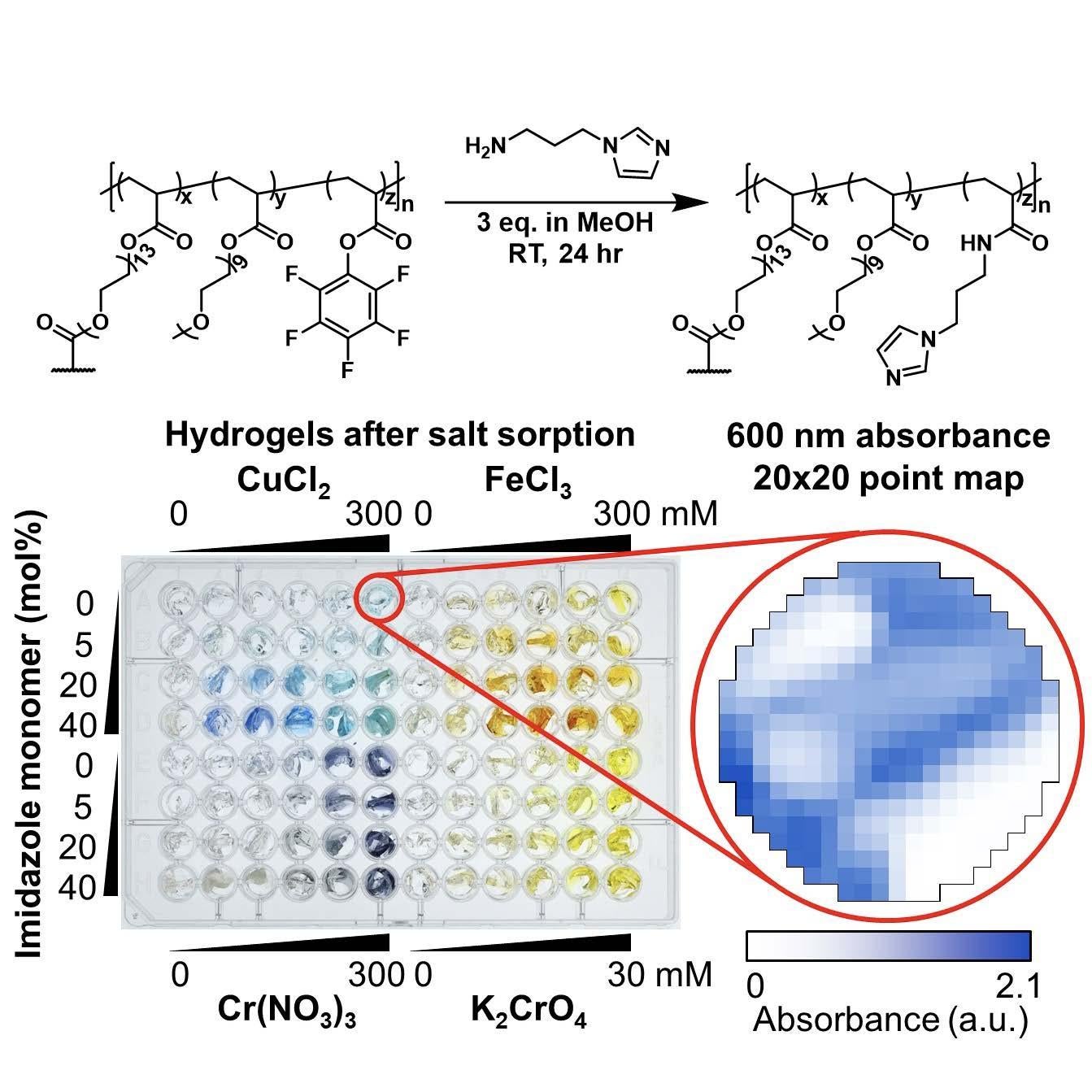
Fig. 5.3. (Left) Picture of 96 well plate containing in situ synthesized hydrogels based on the non-porous UMCP functionalized by imidazoles (to varying monomer fractions). Uptake of transition metal salts of varying concentration is obvious to the naked eye (left) and (right) prototypical example of spatially resolved measurements of absorbance at 600 nm.
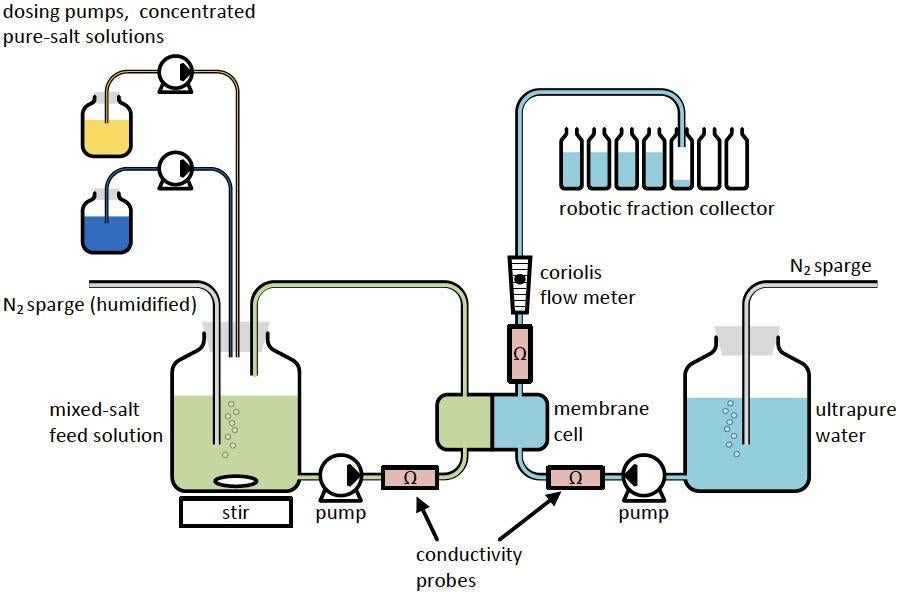
Fig. 5.4. Automated permeation analyzer for single and mixed salt systems. All components are automated and can be controlled and monitored online.