IF, Project 4: Operando Characterization of Assembly Pathways in Integral Asymmetric Membranes
While GAP C will utilize the UMCP block polymer library to understand and develop the formation process of isoporous asymmetric membranes via SNIPS/NIPS, in the IF, Su, Crumlin and Katz will develop the unique and critical operando X-ray scattering tools necessary to track each stage of the SNIPS process, as shown in Fig 5.6. As discussed in GAP C, the process by which block copolymers are processed to form isoporous asymmetric membranes is a non equilibrium process that is empirically optimized for each new chemistry. Via the development of operando sample stages and high sensitivity/speed detectors capable of capturing micro to millisecond snapshots for hard X-ray scattering, the IF will develop tools that can uniquely monitor both the initial solvent casting of the block copolymer micelles and then the non-solvent immersion processes that comprise SNIPS, whose mechanism has heretofore been the subject of intense speculation. The high flux of synchrotron X-rays will provide fast snapshots during the critical 15–60 seconds after solvent evaporation begins during the membrane casting process. The desired 10–100 nm characteristic length scale in the isoporous skin layer is ideal for the length scales that SAXS can probe. Moreover, in situ grazing incidence SAXS (GISAXS) will enable enhanced surface sensitivity, which is relevant to the isoporous layer that exists only in the top few hundred nanometers of the membrane. Further, we will leverage and advance recent developments at the ALS in in situ liquid resonant soft X-ray scattering (RSoXS) to probe polymer micelles and precisely discriminate the spatial extent of the core vs. shell regions of micelles, based on the ability to selectively enhance contrast between polymer blocks by tuning the incident X-ray energy. A second sample cell will be developed to follow the immersion process through which an open porous structure is developed during SNIPS/NIPS. Moreover, by combining GISAXS with transmission SAXS, we can track structure formation of features of up to 100s of nanometers on the membrane surface and through the membrane thickness.
Integral asymmetric isoporous membranes can also be fabricated in a hollow fiber geometry. This geometry is significant because the hollow fiber is one of two (along with flat sheet) dominant form factors used for current membranes. In situ SAXS with the X-ray beam positioned at various distances from the spinning nozzle will provide information on the kinetics of structural rearrangements after extrusion. M-WET will extend our past structure formation of flat sheet membranes to hollow fiber geometries and leverage our access to multiple ALS and NSLS-II SAXS beamlines with varying casting-conditions of pre-formed membranes to connect processing conditions to membrane characteristics. The novel UMCP platform will provide a route towards isoporous membranes with functionalizable hydrophilic pore walls. Synchrotron infrared nanospectroscopy (SINS) and resonant X-ray scattering will be used to map nanoscale morphology with chemical sensitivity, through unique IR signatures of specific functional groups and tunable scattering contrast, respectively. This will also provide a route to spatially resolve the distribution of adsorbed solutes in membranes exposed to complex waters. Thin films cast from micellar solutions have been shown to attain morphologies similar to thicker membranes300, and these thin films will be ideal for transmission RSoXS studies to decipher both the distribution of each domain in a phase separated multiblock copolymer and the impacts of hydration.
GAP C (Sanoja) will provide foundational knowledge of polymer mechanical properties and merge with the operando characterization developments in IF to simultaneously track membrane mechanics and morphology. The ALS has tensile testing stages for the SAXS/WAXS beamline and a vacuum-compatible tensile tester for the RSoXS beamline. These will serve as a starting point for in situ scattering measurements during stretching, which will provide new insights into how morphological parameters, e.g., domain size and separation, influence mechanical behavior. M-WET will further develop custom sample cells specific to isoporous membranes.
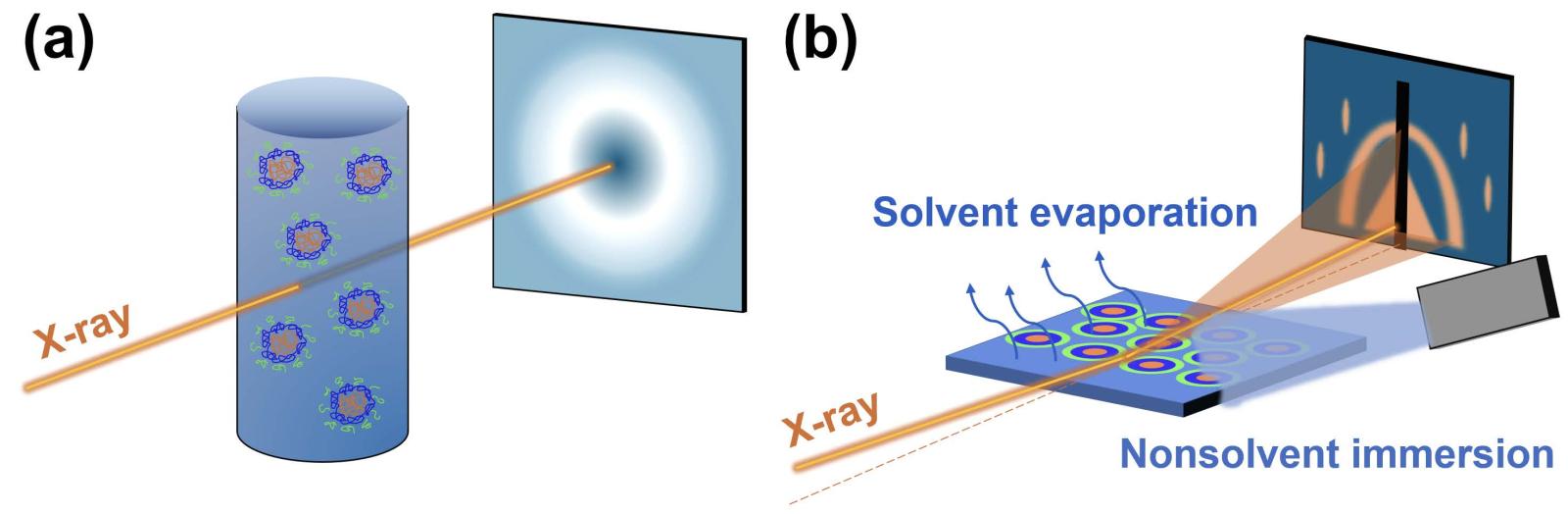
Fig. 5.6. Operando scattering can probe (a) micelle structure in solution and (b) self-assembly during solvent evaporation or phase separation during nonsolvent immersion.