IF, Project 3: Operando Visualization of Membrane Fouling
One key area of interest across the GAPs is identifying membrane functionality that promotes fouling-resistant behavior and improves selectivity. Within the IF, Project 3 will work across GAPs to elucidate new fundamental understanding of membrane fouling with the model systems and UMCP-derived membranes, providing critical chemical and nano- to mesoscale information to inform synthesis and theory efforts. The IF will characterize the processes that control novel membranes through in situ and operando measurements to capture sorption, nucleation, aggregation, specific interactions among membrane foulants, cake/gel layer formation, and decreased macroscopic membrane performance (Su, Crumlin, Katz, Freeman).
M-WET’s groundwork studies to characterize membrane fouling (e.g., Fig. 5.5) reveal the importance of building on Su and Katz’s recent success in applying tender resonant Xray scattering (TReXS) and resonant soft X-ray scattering (RSoXS) and expanding to characterize fouled RO membranes under realistic membrane operating conditions (e.g., hydrated, flowing, pressurized). Scattering will be coupled with element-specific NEXAFS spectroscopy to reveal molecular-level interactions (e.g., ion bridging interactions and speciation changes) in fouling layers (Fig. 5.5d). The IF will develop pressurized crossflow cells for operando scattering (SAXS/WAXS) and spectroscopic measurements (NEXAFS and EXAFS). Although previous work has used X-ray scattering to track mineral nucleation and growth and organic matter fouling, significant tangential flows and higher pressures are needed to mimic ultrafiltration and reverse osmosis conditions. Development of an operando crossflow cell will enable time-resolved scattering measurements with hard and tender X-rays to track fouling mechanisms (e.g., mineral nucleation and growth, organic adsorption/bridging and particle deposition/aggregation) and relate these molecular-level interactions to membrane performance. We will build off M-WET’s previous work on model track-etched membranes fouled with latex beads, where the well-defined form factors of cylindrical pores and spheres allowed scattering profiles to be fit to multiple population models, to advance scattering-based methods of distinguishing between internal and external fouling and to independently track the contribution of each during fouling. Experiments using complex water chemistries within the MFP will reveal synergistic interactions among foulants (e.g., silica and organic foulants) and inform material design in GAP A, identifying membrane functionality and/or chemical speciation that promotes anti-fouling behavior. We will focus on neutral and ionic foulants and surface functionalizations studied in GAP A. Real-time fouling studies will begin with hard X-ray scattering and spectroscopy measurements, which are performed at ambient conditions. In situ resonant scattering (RSoXS and TReXS), pursued simultaneously, will leverage recent developments in vacuum-compatible flow cells.
This complementary set of X-ray spectroscopy and scattering techniques will provide the chemical and spatial sensitivity for real-time tracking of fouling layer buildup and the temporally changing composition and nanoscale distribution within fouling layers (e.g., the amount of Ca2+ or other ions and ion clustering within the fouling layer) as a function of exposure to complex waters across the MFP. Operando nanoscale characterization using pressurized, crossflow cells that mimic macroscopic membrane measurements will provide a bridge between membrane chemistry and performance.
The IF’s operando measurements will be guided by theory and simulation. M-WET has leveraged Su’s experience in direct simulations of NEXAFS spectroscopy and applied the Many-Body X-ray Absorption Spectra (MBXAS) methodology based on density functional theory to understand local environments around specific fouling-relevant species (e.g., calcium-carboxyl interactions). The IF will continue to advance quantum chemical calculations and combine these equilibrium-based calculations with atomistic and coarse-grained dynamic simulations, leveraging expertise in GAPs B and C (Fredrickson, Henkelman, Ganesan) to correlate measured spectroscopic and scattering data to molecular-scale microenvironments and nanoscale phases.
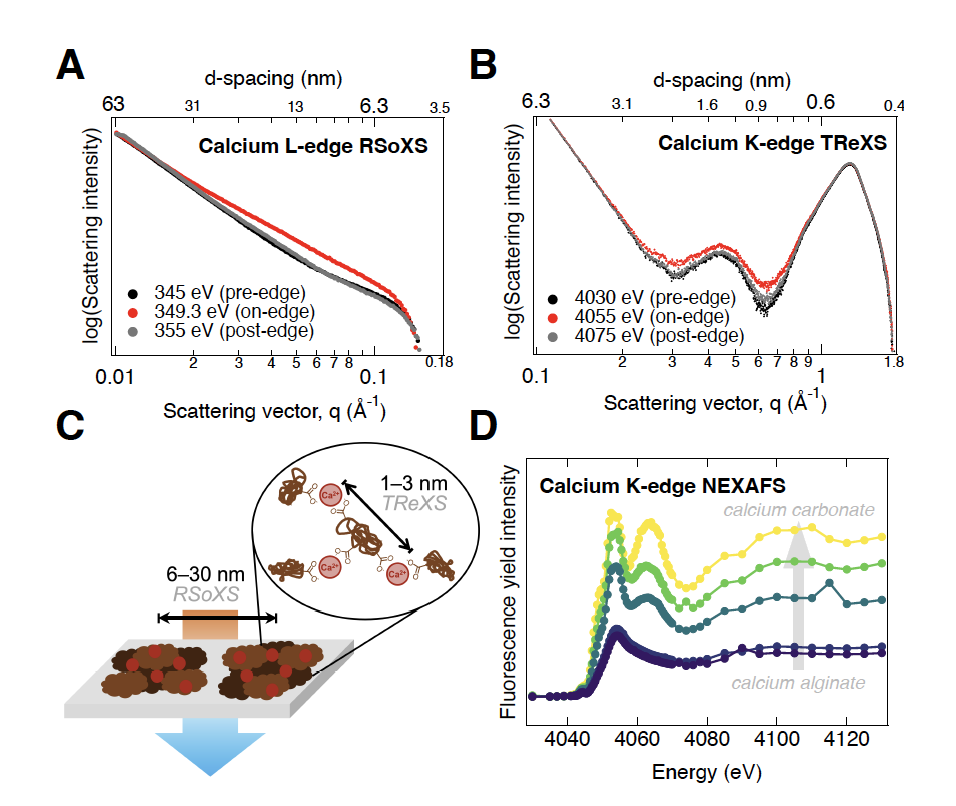
Fig. 5.5. Enhancement of on-resonance scattering intensities at the Ca2+ (a) L-edge and (b) K-edge reveal (c) ion spacing between (RSoXS) and within (TReXS) NOM aggregates on RO membrane surfaces. (d) Ca2+ K-edge NEXAFS spectroscopy shows a shift in fouling mechanism from calcium-carboxyl bridging to calcium carbonate precipitation with increasing CaCO3 oversaturation.